Projects / Tools, trust, and small places: a community data trust in Hoy and Walls
Tools, trust, and small places: a community data trust in Hoy and Walls
A practice-based dissertation exploring whether a community data trust could work for household energy data in Hoy and Walls – and what the islands taught me about the limits of digital tools in small places.
Exploring Community Data Trusts in Small Places
I began this project optimistic about community data trusts. I'd seen how well other tools have settled into the work of community organisations in Orkney, particularly in community energy: a wind turbine, sited and owned locally, can fit the rhythms of a place and generate real benefit for the people who live there. I wanted to find out whether a digital equivalent might do the same for household energy data in Hoy and Walls.
A data trust is a technical and governance mechanism for aggregating data so that grassroots groups can benefit from the usefulness of that aggregation (Viljoen, 2021). For a community data trust, I imagined this being hosted by a local development trust: the kind of place-based organisation, with a local democratic mandate, that we're used to working with in community energy in Scotland. Household energy data is a useful thing to aggregate at this scale because it tells you about consumption patterns on the island, which matters for using more locally generated energy and for any future integration into smart grids.
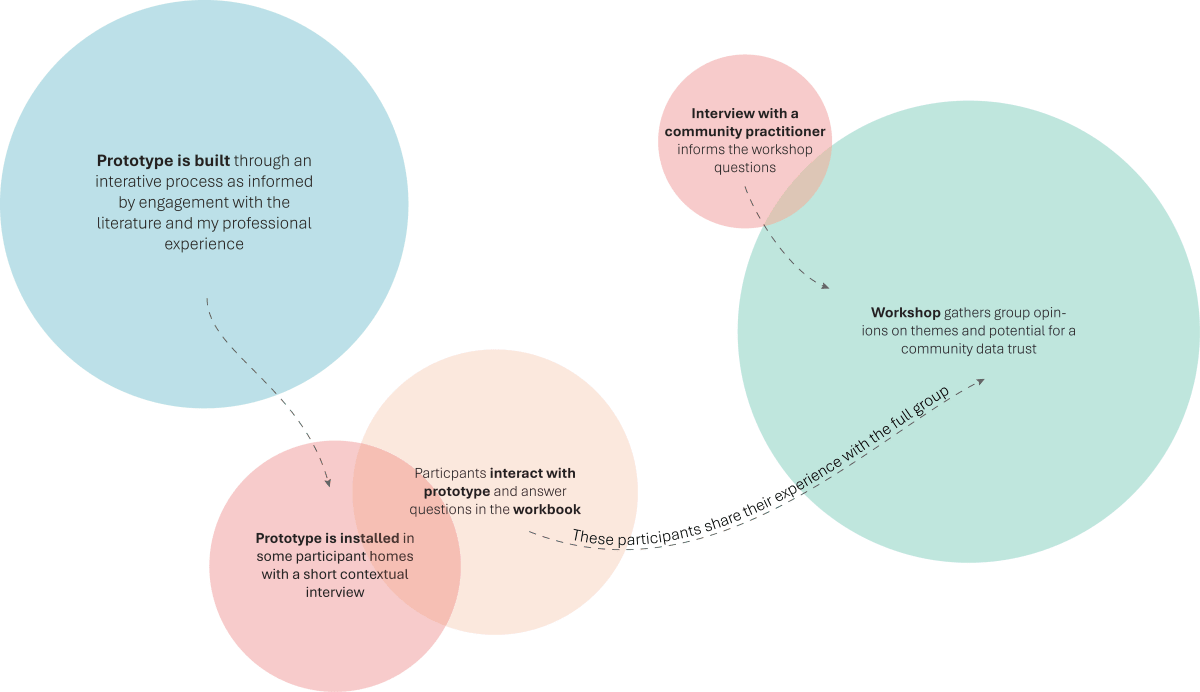
The dissertation was the central piece of my MSc in Data, Inequality and Society at the Edinburgh Futures Institute. I built a prototype community data trust from scratch (read more about this in my post Tools, trust, and small places), installed the monitoring devices in people's homes, ran contextual interviews, and held a workshop on the islands. The prototype wasn't the point in itself; it was a thing to think with, something concrete enough that people could respond to it rather than to an abstract idea.
What I learned is that not every tool has the right affordances for community processes to flourish. Community, as Rebecca Ford writes, is not a noun but a verb – something we do together: the way we live and work in a place, in tension with one another, in a slow business of shared meaning making. These processes need the right context and settings, and the digital tools I was working with didn't offer those. People felt an aversion to them, partly because digital tools are so closely associated with extraction, and partly because being legible inside a small community can make you vulnerable in ways that being legible inside a large one doesn't. There's also a question in the literature, which I didn't fully appreciate going in, about whether community ways of knowing can be translated into digital knowledge at all without losing what made them useful.
The conversations on Hoy and Walls reframed how I think about tools. People's caution wasn't apathy or a lack of digital confidence. It was a form of wisdom that lives inside community processes themselves, and it took the project somewhere I hadn't expected. I've come to see tools less as neutral objects that communities adopt, and more as something that forms a new assemblage with the people using them, generating new ways of being in the world together. Whether those new ways of being are good ones is a separate question, and not one the tool answers on its own.
There is a harder finding underneath all of this, which I want to be honest about. Even the prototype I built to question extractive data infrastructures depends on extractive ones: Amazon Web Services for hosting, a commercial API for the energy readings, and coding languages and practices that aren't accessible to most of the people the tool is meant to serve. That last point matters as much as the others. A tool that only its builder can maintain isn't really a community tool.
I'm leaving this project more cautious than I started it, but not pessimistic. Community organisations are increasingly expected to interact with digital tools, and I worry about what that's doing to the processes that make them work. I'd like to study it more. I'm also still hopeful that if we ask the questions in the right way, we might imagine tools that really do fit the kind of work these organisations do.
I'm hoping to publish a version of this work in an academic journal in due course. In the meantime, I'm happy to share the full dissertation text with anyone who'd like to read it – just get in touch.
References
Ford, R. (2024) 'Community is not a Noun', Writing into Place. Available at: https://writingintoplace.publicarcomopractica.com/community-is-not-a-noun (Accessed: 3 June 2024).
Viljoen, S. (2021) 'A relational theory of data governance', The Yale Law Journal, (2), pp. 573–654.